
What Taiwan's Class 2 fire resistance means, how it differs from flame-retardant and fire-rated products, and where Lienchy's laminated metal is used.
Understanding Class 2 fire resistance
What is Class 2 fire resistance (耐燃二級) in Taiwan?
Class 2 fire resistance is one of three grades Taiwan uses to rate how building materials react to fire. It shows whether a material used for interior finishing would feed a fire: the higher the grade, the less heat the material releases when exposed to fire, so the fire spreads more slowly and there is more time to escape. Taiwan's building code requires ceilings, walls and other interior finishes to meet a minimum grade depending on the building's use.
The grade is determined under the Taiwan national standard CNS 14705-1, a cone calorimeter test. For Class 2, the material is heated for 10 minutes and must meet all three criteria:
- Total heat release: no more than 8 MJ/m², meaning the material gives off little heat as it burns.
- Peak heat release rate: never above 200 kW/m² for more than 10 seconds, meaning the material does not suddenly burn fiercely.
- Cracks and holes: no cracks or holes that go through to the back, meaning the material is not easily broken down by the fire and flames cannot pass through to the other side.
In Taiwan, Class 2 fire resistance is also commonly called "二級防火" (Class 2 fireproof).
→ Further reading:Laminated Metal
Sources:BSMI Q&A on fire-resistance grades (Chinese only)BSMI Q&A on purchasing safety products (Chinese only)Building Technical Regulations (Design and Construction), Article 88 (Chinese only)
How do Class 1, Class 2 and Class 3 fire resistance differ?
All three grades use the same test method. The difference is how long the material must hold up under heat: 20 minutes for Class 1, 10 minutes for Class 2 and 5 minutes for Class 3. The longer the time, the better the material resists the heat of the early stage of a fire. For Class 1 composite materials, the main body of the material, that is, the substrate such as the base board or bottom layer, must also be tested on its own. For example, for a composite board made by bonding other materials to a calcium silicate board, the calcium silicate board itself is tested separately.
Taiwan's building code also uses these grades to name materials, and the names often appear in drawings and regulations:
| Grade | Name in the building code | What it means | Examples listed in the code |
|---|---|---|---|
| Class 1 | Non-combustible material (不燃材料) | Does not burn, melt, crack or deform in a fire, and gives off no harmful gas | Concrete, brick, tile, stone, steel, aluminum, glass, mineral wool, ceramics |
| Class 2 | Fire-resistant board (耐火板) | Hard to ignite; can be used where the code requires Class 2 or above for interior finishing | Wood wool cement board, fire-resistant gypsum board |
| Class 3 | Fire-retardant material (耐燃材料) | Meets Class 3; burns less easily than ordinary materials | Fire-retardant plywood, fiberboard and plastic board, gypsum board |
Class 2 is a grade commonly specified for interior finishing. It burns less easily than Class 3, and compared with the non-combustible materials listed in the code, such as concrete, stone and glass, Class 2 materials offer more flexibility in finish, weight and installation, combining fire performance with good interior design.
→ Further reading:Laminated Metal
Sources:Building Technical Regulations (Design and Construction), Article 1 (Chinese only)BSMI Q&A on fire-resistance grades (Chinese only)Ministry of the Interior letter No. 1090800805 of February 3, 2020, on substrate tests for Class 1 composites (reposted by the Taiwan Architecture & Building Center, Chinese only)
How is Class 2 fire resistance different from flame-retardant items and fire-resistance ratings?
All three terms relate to fire safety and their English names look alike, so they are often mixed up, but in Taiwan they rate different things. Fire-resistance classes (耐燃) rate whether a building material feeds a fire, flame-retardant certification (防焰) rates whether items such as curtains and carpets let a fire spread, and fire-resistance ratings (防火時效) show how long a whole wall or door can hold back a fire.
| Item | Fire-resistance classes (耐燃, Class 1 to 3) | Flame-retardant items (防焰) | Fire-resistance rating (防火時效) |
|---|---|---|---|
| What is rated | Interior finishing materials, such as ceiling and wall panels | Curtains, carpets, stage curtains, display boards and similar items | Building elements: columns, beams, walls, floors, doors |
| How it is tested | A small sample is heated and the heat it releases while burning is measured | A flame is applied at a 45° angle; the time for the flame to go out and the charred area are measured | The whole assembly, such as a wall or a door set, is heated from one side in a fire-test furnace |
| Purpose of the test | To confirm the material releases little heat in a fire, so it does not fuel the fire and make it grow | To confirm a fire does not spread along the fabric or material, and goes out quickly once the ignition source is removed | To confirm the element stays standing for the rated time and stops flames and heat passing to the other side, so the fire does not spread to other spaces |
| Grades | Yes: Class 1, 2 and 3 | No: items that pass carry a flame-retardant marking | Shown as time, such as 30 minutes, 1 hour or 2 hours |
| Taiwan rules and standard | Building Technical Regulations; test standard CNS 14705-1 | Fire Services Act; flame-retardant performance test standard | Building Technical Regulations; test standard CNS 12514 (fire doors: CNS 11227) |
Common misconceptions:
- The fire-resistance class of a board and the fire-resistance rating of a wall are assessed separately. The class describes the board itself, while the rating comes from a furnace test of the complete assembly, including the frame, infill and joints, so a wall's rating is confirmed by testing that assembly.
- Fire-resistance classes and flame-retardant markings apply to different materials. Fire-resistance classes are mostly used for interior building materials such as ceiling and wall panels, while flame-retardant markings are mostly used for decorative items such as curtains, carpets and stage curtains.
- A door made with fire-resistant materials is not necessarily a fire door. Fire doors are assessed by the fire-resistance rating from a furnace test of the complete door, including the door leaf and frame.
These grades and markings are part of Taiwan's own system. For projects outside Taiwan, check which test and rating your local code requires, and contact us if you need more details.
→ Further reading:Laminated MetalContact Us
Sources:Building Technical Regulations (Design and Construction), Article 1 (Chinese only)Article 70 (Chinese only)Fire Services ActFlame-retardant performance test standard (Chinese only)BSMI Q&A on purchasing safety products (Chinese only)
Lienchy Metal's Class 2 certification
Is Lienchy Metal's laminated metal certified Class 2 fire resistant?
Yes. Lienchy Metal's laminated metal products are certified Class 2 fire resistant, so they can be used where Taiwan's building code requires Class 2 or above for interior finishing materials.
→ Further reading:Laminated Metal
Can you provide proof of Class 2 fire resistance for your laminated metal?
Yes. Lienchy Metal's Class 2 fire-resistance approval notice for its laminated metal is shown below. If you need more detailed specifications or other documents, send us a request and our team will help.
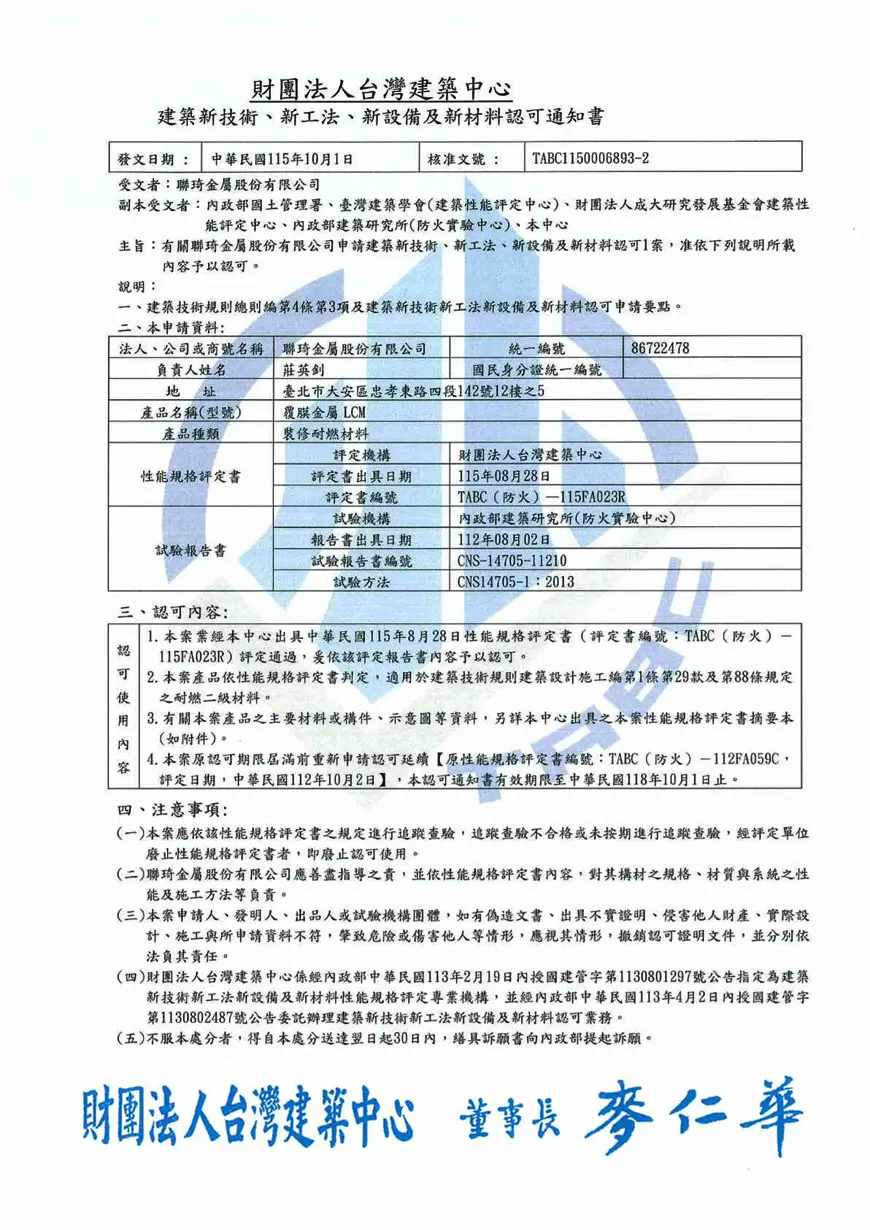
→ Further reading:Contact Us
Where Class 2 materials are used
Where are Class 2 fire-resistant materials usually used?
Class 2 materials are mainly used for interior finishing, such as ceilings, walls, partitions and corridors. Taiwan's building code sets the minimum fire-resistance class for interior finishes according to the building's use, floor and type of space; requirements are higher for spaces that hold many people, are harder to escape from, or contain a source of fire. For example:
- Basements: where a basement is used for assembly, offices or shops, interior finishes in habitable rooms must be Class 2 or above.
- Rooms without windows: habitable rooms without enough windows or exterior openings need Class 2 or above.
- Rooms with combustion equipment: rooms with equipment such as boilers need Class 2 or above.
The class required for a given project depends on the building's use and drawings, and is decided by the architect or interior designer.
→ Further reading:Laminated Metal
Sources:Building Technical Regulations (Design and Construction), Article 88 (Chinese only)
Where is Lienchy Metal's Class 2 laminated metal used?
Lienchy Metal's laminated metal combines Class 2 fire resistance with a wide choice of wood grain, stone and metallic finishes, making it well suited to interiors that must meet fire rules and still look good, such as office buildings, shopping malls, hotels, hospitals and schools. Common uses include:
- Walls: wall panels, wainscoting and office partition panels.
- Ceilings: light steel frame ceilings and grille ceilings.
- Elevators: elevator wall panels and doors.
- Panels: cold room, freezer room and clean room panels.
The metal substrate is strong and the surface is easy to clean, so it lasts longer than wood or plastic boards. For outdoor use, choose the more weather-resistant PVF or PVDF laminated metal.
→ Further reading:Steel Wall PanelLight Steel Frame CeilingGrille CeilingElevator Interior DesignPartition PanelCold Room PanelClean Room Panel